Compliance · FBR · digital invoicing · sales tax · compliance
FBR POS Integration in Pakistan: What Businesses Need to Know
FBR POS integration explained for Pakistani businesses: how sales data transmits to the FBR, why QR receipts matter, what provincial taxes add, and how to pick a genuinely compliant POS.
POS Pakistan Team 28 Jul 2026 9 min read
FBR POS integration is the requirement that registered retailers and restaurants transmit sales data to the Federal Board of Revenue through an FBR-integrated POS system — and print a scannable QR on every receipt. It is not optional for registered businesses: the FBR has run the program since 2015 and has tightened enforcement each year, most recently with QR-based digital receipts that allow the FBR app to verify any sale on the spot.
If you sell from a registered business in Pakistan, this guide covers who must comply, how an integrated POS actually works day to day, what the provincial tax bodies add, and how to avoid buying a "POS" that leaves you non-compliant.
What FBR POS integration actually means
A POS system is only "FBR-integrated" when sales data flows from your till to the FBR in real time (or near-real time), through an FBR-approved mechanism. In practice this means three things happen on every sale:
- The sale record — invoice number, items, prices, and tax — is transmitted to the FBR backend.
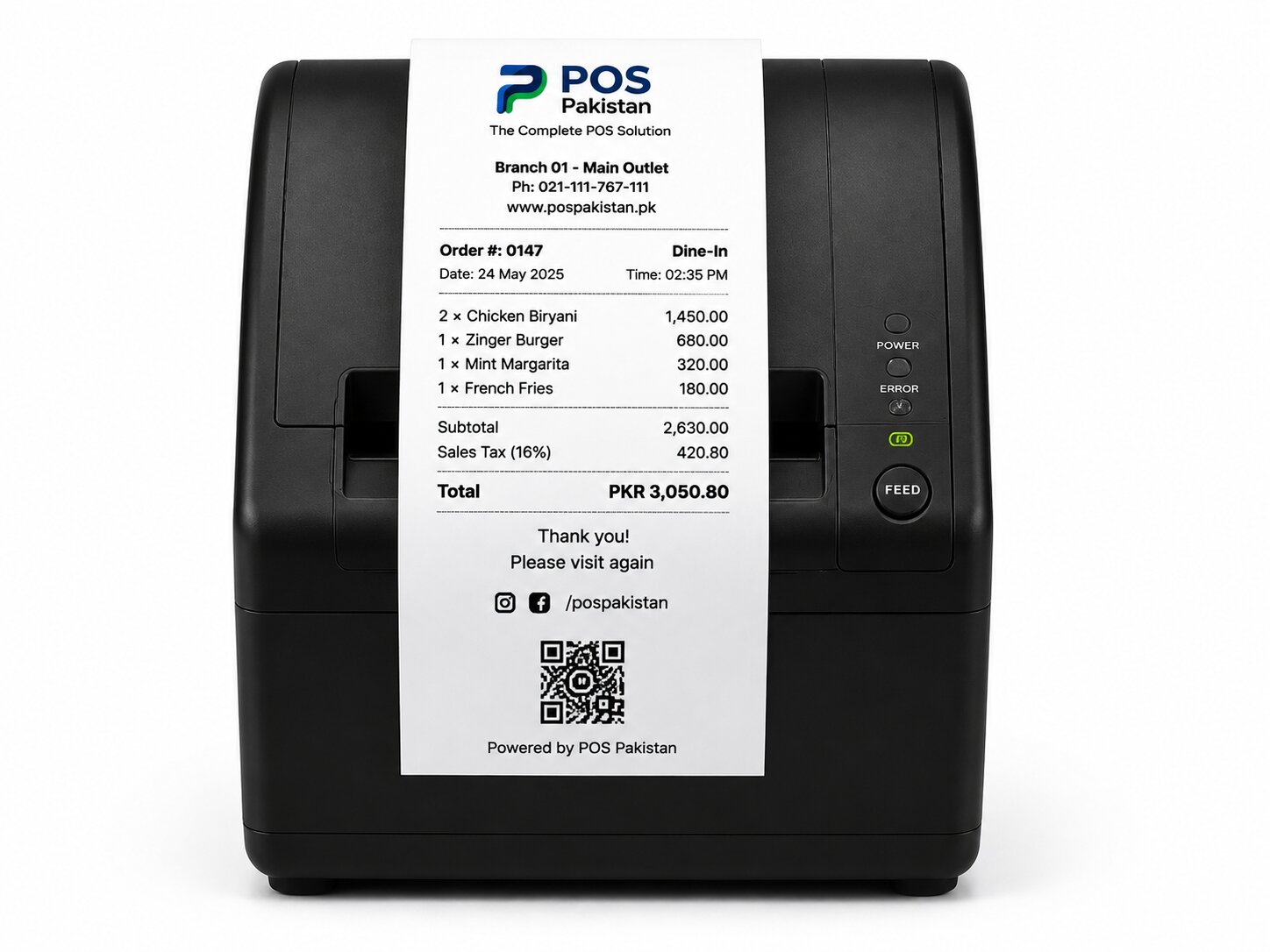
- The FBR returns a verification response, and the receipt prints a QR code that links back to the filed record.
- The receipt itself carries the verified invoice details, so an FBR inspector (or the FBR app) can scan and confirm the sale was reported.
A machine that merely prints "FBR integrated" on the receipt but never transmits data is not compliant. If your current vendor cannot show you the integration working end to end, you are carrying the compliance risk — not them.
Who has to comply
The FBR requires POS integration from registered businesses based on turnover tier and business type. In broad terms:
- Large retailers (e.g., grocery chains, electronics, apparel) have been the focus of enforcement since 2015–2016.
- Restaurants, fast-food outlets, and hotels were brought under mandatory POS integration and faced the most aggressive enforcement pushes in the last few years.
- Tier-based requirements mean smaller registered traders get progressively more time, but every registered retailer or restaurant should plan for integration rather than assume exemption.
The safest test is your own status: if you are sales-tax registered (or should be), plan for integration. The FBR app's receipt scanner already allows customers and inspectors to verify any QR receipt, so visibility is effectively public.
Provincial taxes on top of FBR
Pakistan's four provinces collect their own sales tax on services, which interacts with the federal system:
- SRB (Sindh) — restaurants in Karachi, Hyderabad, and the rest of Sindh pay service tax through the Sindh Revenue Board, and SRB has run its own POS integration program for years.
- PRA (Punjab) — Punjab Revenue Authority covers restaurants and services in Lahore, Faisalabad, etc., with its own QR receipt requirements.
- KPRA (KP) and BRA (Balochistan) — the same structure, smaller volume.
A compliant POS for Pakistan handles both layers: federal FBR transmission plus the correct provincial rate and filing per province where you operate. This is one of the main reasons a locally built system beats imported software — the tax engine has to know the difference between an SRB restaurant in Karachi and a PRA restaurant in Lahore.
What happens if you don't comply
Enforcement has moved beyond notices. Common outcomes for non-compliant registered businesses:
- Sealing / closure orders — most visible in the restaurant sector; outlets have been sealed for running non-integrated tills.
- Penalties and surcharges on unpaid tax, plus default surcharge that accrues monthly.
- Retroactive assessments — if your sales data was never reported, authorities can estimate and assess from the records they do have (bank deposits, utility usage).
- Public visibility — QR-receipt verification makes it easy for customers and inspectors to confirm whether a receipt is genuine and filed.
The operational point is simple: in 2026, running a registered retail or restaurant business in Pakistan without a genuinely FBR-integrated POS is an avoidable, increasingly expensive risk.
How to choose a compliant POS
Use a checklist, not marketing copy. Before signing with any vendor:
| Check | Why it matters |
|---|---|
| Working FBR transmission, demonstrated live | "Integration available" ≠ "integrated today". Ask for a live demo of a sale going to FBR and a QR printing. |
| Provincial tax handling per province | Confirm SRB/PRA/KPRA/BRA rates and filing support match your locations. |
| Offline sale handling | Pakistan's power and internet reality means sales happen when the line is down — the POS must queue and transmit later, still producing valid receipts. |
| You own your sales data | Confirm you can export the full invoice history even if you leave the vendor. |
| Local support and update responsibility | If FBR changes the format, the vendor must ship the update — a foreign product may take months or never. |
What POS Pakistan does on FBR
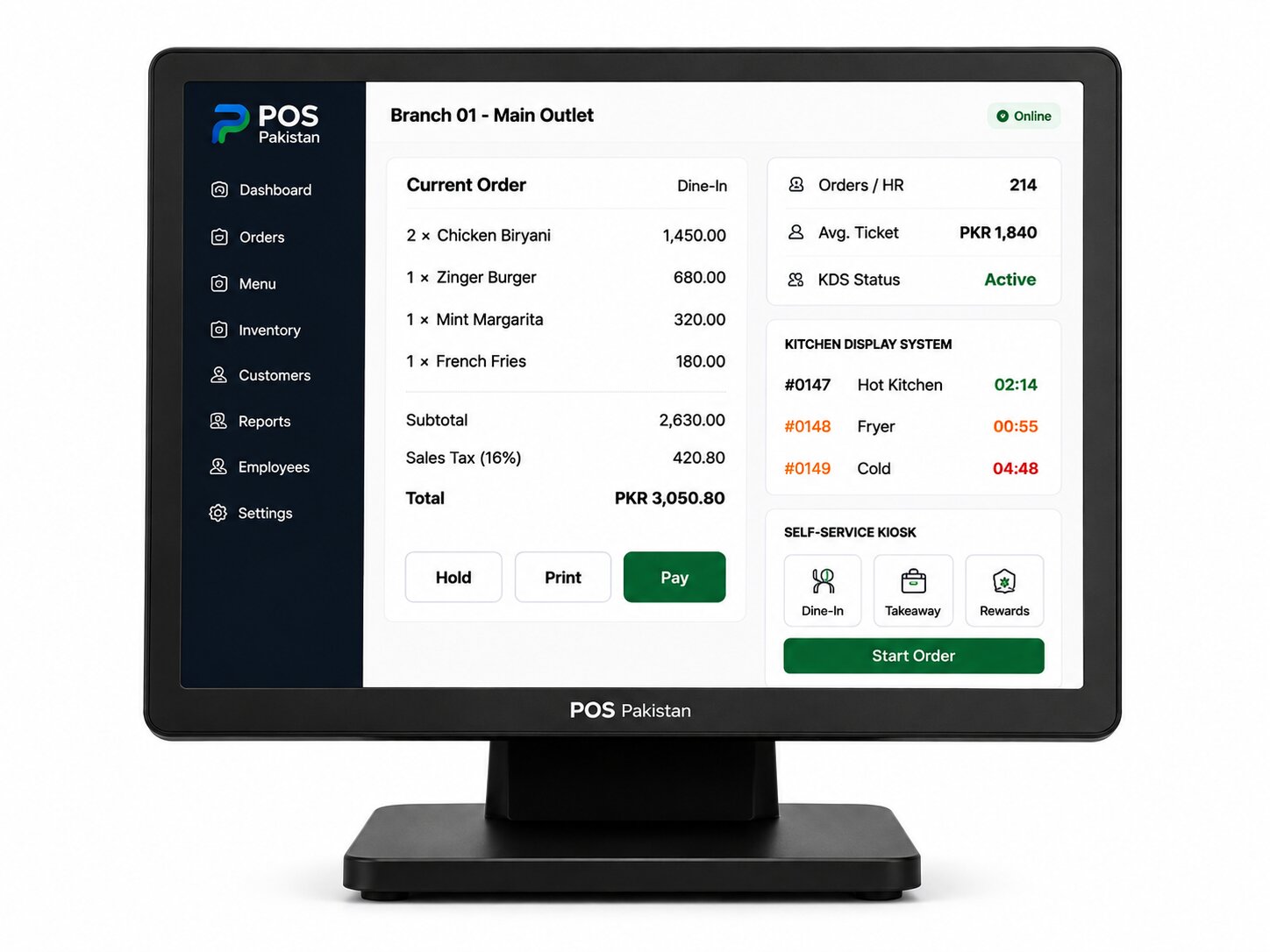
POS Pakistan transmits sales to FBR-integrated digital invoicing with real-time verification and prints a scannable QR on every receipt, across restaurant and retail tills. Provincial tax is handled per province — PRA, SRB, KPRA, BRA — so a multi-city chain gets the right rate and filing support at every branch. Offline mode queues every sale during an outage and transmits the moment the connection returns, so a busy Friday night never produces unreported sales.
If you want the step-by-step of registering your tills with the FBR, our guide to POS registration walks through the process. For the product itself, see FBR-integrated invoicing, and how it fits into restaurant or retail operations.
Where this fits in the platform